
Finding ways to help you cope with Alzheimer’s is a priority in the early stages.
Unfortunately, there is no cure at present for Dementia or Alzheimer’s. However, there are ways to help you cope with the diagnosis and slow the progression down.
What are the signs of Alzheimer’s disease?
Alzheimer’s is a progressive disease as the brain deteriorates. The signs are when memory problems affect someone’s daily life. Such as:
- Frequently losing items around the house.
- Forgetting a name or the right word in a conversation. This progresses onto them repeating themselves and not able to follow a conversation.
- Forgetting recent conversations or events.
- Getting lost in a familiar place. Their orientation is affected, finding it harder to be spatially aware.
- Forgetting appointments or significant dates. This progresses onto losing track of days, time, and dates.
- Struggling with making decisions and completing simple tasks.
- There will often be a change in mood and changes in behaviour. Becoming unusually anxious or irritable, denial, fear and losing interest in their usual activities.
Anyone finding things difficult should ask for support from a GP or other professional. The Alzheimer’s Society has lots of information.
What causes Alzheimer’s?
Our brain is constructed of billions of neurons, connecting with each other by neurotransmitters, forming patterns of behaviour and memories.
Whilst we are awake these connections build up a debris in the brain. One of the harmful products is a protein called beta-amyloid, which is associated with Alzheimer’s disease. The protein builds up in time and forms abnormal structures, or plaques. The connections are compromised, signals reduce, and nerve cells die resulting in brain tissue lost. The drug treatment can help boost some of the neurotransmitters to help alleviate some of the symptoms.
In the early stages this damage occurs in the hippocampus. The area of the brain associated with day-to-day memories, or short-term memory. Therefore, long-term memory isn’t affected in the early stages of Alzheimer’s.
So, when we sleep our bodies and brain repair. Beta-amyloid, amongst other toxins, are flushed out with cerebrospinal fluid through our glymphatic system. If we don’t get enough sleep, the glymphatic system won’t be working optimally, these plaques can build up, causing harm to the brain tissue and memory function over time.
Ways to help slow down Alzheimer’s
Thinking that you have Alzheimer’s disease can be frightening for the person and their family. It can be difficult to talk to others about your symptoms and feelings. But doing this will help to get the support you need.
There is no cure at present, however there are medicines that can help slow down Alzheimer’s progression in some people. Your GP would be able to prescribe medication if eligible.
There are other ways to help you cope with Alzheimer’s such as:
- Take care of your physical and mental health. Remain active, maintain a balanced diet, have positive interactions with others and avoid alcohol which influences cognitive behaviours!
- Have a good night sleep.
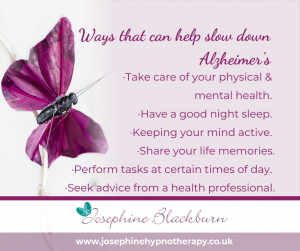
- Keeping your mind active with word and number puzzles. Keep going to groups you’ve always done.
- Share your life memories with others or create a journal.
- Perform tasks at certain times of day when you are most alert.
- Seek advice from a mental health professional. This will help control the feelings of anxiety or depression and help find other coping techniques. This is important for the person with dementia as well as the carer as the news affects the whole family. Try this grounding technique.
My family experience.
I have experience of Alzheimer’s through two of my family members. Both very similar with the rapid deterioration, close family acceptance and care of them.
In the first place they were both aware of losing their memory.
Secondly both became violent, including biting and scratching which was hard to control, especially with their adult strength behind it!
They became distant from their loving husbands, who found the rejection incredibly hard.
In contrast they took different paths before becoming silent and peaceful, locked into their vacant world. A blessing when they passed away.
In conclusion a very sad, and cruel disease for everyone.
My Grandma
When I was a teenager, my paternal Grandma developed Alzheimer’s when dementia was quite a taboo subject. Grandad was very protective of her, ‘no one could look after her like he could’ and both him and my aunt cared for her at home. In one of her early lucid moments, she voiced that she wished that she could end it.
She became a ‘depressed Alzheimer’ and spent her awake time periodically wailing and calling out distressed, very wearing for her and them! She became silent as the disease took hold and passed away peacefully.
My Mother-in-law
When Tess, (in the cover photo) developed Alzheimer’s, we recognised signs and suggested she sought advice from her GP. My father-in-law tried to dismiss it and cover up the fact she was losing her memory, again sadly the stigma of dementia.
Quite early on she told me about her past, shared experiences that none of her family knew about. I felt very privileged to have been party to this information.
Dave cared for her at home for as long as he could. She became physically too difficult for him. Driving him to despair and having a detrimental effect on his health. She went into a home and was well cared for there. Unfortunately, this all contributed to sending him to an early grave.
She became more of a ‘happy Alzheimer’, counting in the same pattern, nonsense speak, then laughing. Again, she became silent as the disease took hold and passed away peacefully.
In conclusion
So, one of the main lessons from both experiences are to act on it before it is too late and accept the help.
There is help and support for the person with Alzheimer’s and the family around them.
Hypnotherapy won’t cure the disease, but we talk about ways to help you cope with Alzheimer’s.
We help you to focus your mind on the achievable, reduce anxiety, to achieve better sleep patterns, manage your fears, and give you many different coping techniques.
I am fully qualified through AfSFH and sessions are either in person or online over zoom.
Contact me for more information on how Hypnotherapy can provide ways to help you cope with Alzheimer’s.