
We’ve heard a lot about Wellbeing and Self-Care since the Pandemic. In this blog I will give you some guidance on How to Self-Care.
What is the difference between Wellbeing and Self-Care?
Wellbeing
This is important to our mental health. For more information and tips, read my previous blog on The Five Steps to Wellbeing.
Good mental wellbeing includes the presence of positive emotions and moods, having contentment, happiness, satisfaction and purpose with life, fulfilment, and positivity.
Poor mental wellbeing means you find it more difficult to cope with daily life, have a lack of energy and enthusiasm to carry out simple daily tasks, you have negative emotions and thoughts, feel more withdrawn from others, and may battle with depression and anxiety.
Self-Care
 ‘The practice of taking action to preserve or improve one’s own health’ – Oxford Dictionary.
Taking responsibility in looking after our whole being, both physically, mentally, and socially.
When we learn How to Self-Care, then practice daily, we remain healthy, happy, and resilient. I’ve often heard people say, “I don’t have time for myself”, “I put others first”, “I feel guilty if I sit down, I should be ‘doing’”.
However, the positive feeling you get after taking some time and attention for yourself, means you have more to give others.
How do I get started with Self-Care?
Ideally you should give yourself a few minutes of ‘me time’ every day.
Gradually incorporate time into your daily routine, maybe waking a little earlier to practise mindfulness, or go for a walk at lunchtime.
The more you schedule those small nuggets of time, you’ll find it easier to achieve them. Learning to deliberately direct your attention on Self-Care is a skill. As with all skills, to achieve and maintain your goal, takes practice. It will make a difference to your Wellbeing.
Have a look at the tips below, set your boundaries, and plan your first achievable steps to Self-Care.
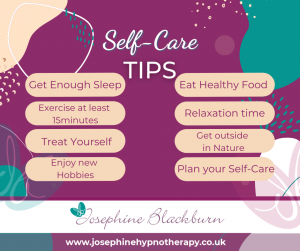
Self-Care Tips
Sleep.
Establish a good sleep routine. If you Can’t get to Sleep, night after night, this will have a detrimental effect on your Mental and Physical Health. In this blog I will explain the health implications of when you Can’t Get to Sleep and give some tips to aid a Good night Sleep.
Diet.
Make sure you have a balanced healthy diet including your 5 a day fruit and vegetables, and protein. There are nutritionists that can guide you into a healthier diet. Message me and I will gladly pass on a few contacts. Hypnotherapy can also help with weight management.
Exercise.
I don’t mean joining a gym that you won’t stick to!
Go for a daily brisk walk, get your heart rate up and it costs nothing!
Go for a bike ride.
Find a local exercise class, one that appeals to you. I enjoy Pilates, Yoga, Zumba, Tap Dancing, and Boxercise. Pilates and Yoga are very good for your core and bone density. The other exercises are great fun, give me the cardio, as well as bone density and strength.
Doing just 15 minutes of exercise at home can make all the difference. Again, I have contacts should you wish to go down that route.
Relax.
Here are some suggestions of what you could do:
Try some mindfulness, 5 – 10 minutes will help focus your mind on you. Try my video on 5-minute Mindfulness, which is attached.
Have a relaxing bath, especially in the evening, as this will help prepare you for bed.
Read a book.
Listen to podcasts, audio books or relaxation recordings.
Treat yourself.
When we have a treat, we feel good. We release our feel-good neurotransmitters serotonin, dopamine, oxytocin, and endorphins.
Having regular Beauty or Holistic therapies, gives us that time to relax and improve our confidence. I’ve been helping people find care and confidence as a Beauty Therapist for over 30 years. The feeling you get after taking some time and attention for yourself, is something I’ve always been pleased to offer.
Get out in nature.
Being out in nature is good for reducing our stress levels as it lessens our cortisol levels. Our heart rate calms, our breathing slows down, and we feel peaceful and positive.
There have been many studies on the effect of nature on our mental health.
The University of Washington studies how time spent in nature helps improve our health.
BBC ‘Trust me I’m a Doctor’, aired the ground-breaking study, of the suggested 120minutes a week in nature to improve wellbeing, stress and mood. Universities of Edinburgh and Exeter carried out the experiment and in 3 weeks the results were incredible.
Whilst you are out in nature, try a grounding technique which I have on my YouTube channel.
Do things you enjoy.
There are lots of different hobbies. Either in social groups learning new skills, or on your own. Baking, photography, DIY, upcycling, drawing, pottery, writing, there are endless opportunities.
Get organised.
Plan what you will find achievable to do in the day. There are various online worksheets to help you plan out things to do, such as this one from Therapist Aid.
How can I help?
I hope you have found my blog useful to you, and that you have found something you can incorporate into your day.
Depending on your general wellbeing, if you are finding it difficult to carry out simple daily tasks, then Hypnotherapy may be the answer. We can create the change you need in your life, by focusing on the goals which will provide that change. In sessions we go through lots of coping techniques to promote relaxation.
There are some guided relaxation techniques such as Tropical Island on my YouTube channel. Listen to it during the day to give your body and mind a rest.
I also offer Beauty and Holistic therapies, take a look at my pricelist for more details.
Find out if I’m the right therapist to guide you on How to Self-Care.
Contact me to book your initial consultation. I am fully qualified, verified and insured.