
So, Why Do We Sleep? Sleep plays a fundamental part in our overall general health. Life throws many stresses at us which disrupt our sleep patterns, causing us to get poor mental and physical health.
Why Do We Sleep?
As we sleep, we:
- Repair and rebuild cells to fight off infections.
- Housekeeping occurs. We create neural connections, memories, throughout the day. As we sleep the brain keeps the connections that are useful and dissolves the ones that are not. We need to clear out the debris from cell metabolism, neurotoxins, via the glymphatic system. One of the harmful products that is flushed out is beta-amyloid, a protein associated with Alzheimer’s disease.
- Memory consolidation. During our sleep, the memories that are stored short term in the Hippocampus are processed and stored in the main cortex in the brain. We process during Rapid Eye Movement, REM sleep, in a stress-free environment in the form of dreaming. For more information read my blog, Why We Dream.
- By doing the memory consolidation we store new facts in the Hippocampus which is then processed into the main cortex; by taking short restful breaks through the day, we increase our learning capacity.
- We feel recharged, refreshed, reenergised, and rebooted to start the day feeling fresh.
What triggers our Sleep?
There are a several factors contributing to Why Do We Sleep. Naturally our circadian rhythm and sleep pressure determine when we are tired. Balance in our lives can help us sleep too. By undertaking some physical activity, controlling our stress, and remaining healthy will mean you are ready for a good night Sleep.
Our Circadian Rhythm.
This is our internal biological clock which is roughly 24hours. Our eyes process the light signals in the optic nerves and triggers the release of Melatonin at dusk. Our levels of Melatonin increase throughout the night, so we get the instruction to fall asleep. The levels decrease again as we sleep, and as soon as daylight is detected the pineal gland shuts down the production of Melatonin.
Sleep pressure.
Throughout the day we break down Adenosine Triphosphate molecules for energy. The by-product Adenosine activates the sleep control neurons near the Hypothalamus. The more we are awake, the more Adenosine builds up, increasing our desire to sleep. After 7-8 hours of healthy sleep all the Adenosine is removed.
Caffeine can block the Adenosine receptors, such as blocking the message that we’re getting tired. However, Adenosine is still building up without us realising because of the caffeine. Which is why we get the ‘crash’ when caffeine wears off. Another important thing to note is that it takes 6 hours for caffeine to be out of your system!
Physical activity.
Make sure you do some Physical activity during the day. This reduces stress and tires you, improving sleep quality and increases our sleep duration. Ideally no exercise within two hours of going to bed. Going for a brisk walk out in nature is a great start to improving your physical activity.
Have balance in your life.
By reducing and controlling your stress levels will naturally aid a good night sleep. Read my blog on What is Stress to find out more. Undertaking a healthy diet and outlook will help you sleep.
How much Sleep do we need?
On average we sleep 20% less than we did! Average sleep in the 1950s was 8 hours compared with average sleep in the UK today of 6.3 hours.
Newborns: 14 –17 hours on an irregular schedule
Teenagers: Need 9 hours. Biologically programmed to go to bed late and get up late!
Adults: Need ideally 7 –8 hours
Can’t Get to Sleep?
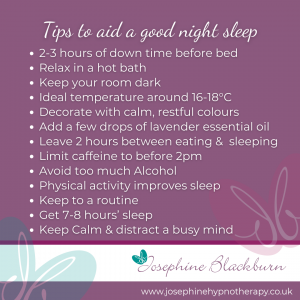
If you Can’t Get to Sleep night after night, this will have a detrimental effect on your Mental and Physical Health. In my blog I will explain the health implications of when you Can’t Get to Sleep and give some Tips to aid a Good night Sleep. Watch one of my techniques to help you sleep.
Why Do We Sleep is answered in Hypnotherapy sessions too. We can help with your sleep disorders in a variety of ways. By reducing anxiety and moving away from depression, controlling your weight, and working through addictions. Listening to the relaxation hypnotherapy recording which helps with neural processing, therefore helping clients to get a good night’s sleep. I am fully qualified through AfSFH and sessions are either in person or online over zoom.
If you are struggling to sleep, book now.
We all have the ability to change…