
The reasons behind Why We Dream and Sleep have been studied for centuries.
A History of Dreams and Sleep
Pre 20th Century
As early as 162AD when Galen, a Greek physician, was one of the first physicians to observe the brain. He understood that sleep clears the mind, and a lack of sleep causes the mind to go fuzzy.
In 1619, Rene Descartes, a philosopher, proposed that because dreams appear very real, our waking senses are illusions. He described the pineal gland, (found in the centre of the brain secreting melatonin to make us feel sleepy), as the “Seat of the Soul”.
However, in 1650 British physician Thomas Willis localised consciousness in the brain, dismissing Descartes theory. He wrote The Anatomy of the Brain.
German psychiatrist Wilhelm Griesinger, in 1868 noted the eye movements occurring at the beginning and during sections of our Sleep.
Into the 20th Century
The world’s first sleep laboratory opened in the University of Chicago 1925 by Nathaniel Kleitman. “The world’s first scholar to concentrate entirely on sleep, Kleitman is universally recognized as the father of sleep research.”
The studies identified our circadian rhythms. The regulation of sleep and wakefulness, and the effects on us when deprived of sleep. He later published a reference book ‘Sleep and Wakefulness’ in 1939 noting that the eye movements are linked to dreaming.
With the use of EEG machines in 1929, showed that there are different levels of electrical activity in the brain, coinciding with different stages of sleep. Brain activity was heightened during the eye movements. When patients were woken during this time, they reported having vivid dreams.
Despite Griesinger noting the eye movement, Rapid Eye Movement (REM) was not actually named until 1953 by Eugene Aserinsky.
Further research learned in 1959, that this REM part of our sleep is like wakefulness because the brain is so active. However, the body is paralysed.
21st Century
Today, the importance sleep and Why we Dream is still being researched by scientists.
A fascinating study by Laura Lewis at Boston Uni, by using MRI, shows that there are also electrical waves in the flushing process of our brain’s toxins. During our deep sleep Amyloids are removed by this method. Watch the video to show what happens.
Cardiff University has a sleep lab where they are “working out how to manipulate sleep in order to improve health and cognition, a field we refer to as ‘sleep engineering’.”
We now know that sleep boosts our brain power and memory. Sleep is crucial, it’s not optional.
What happens when we sleep?
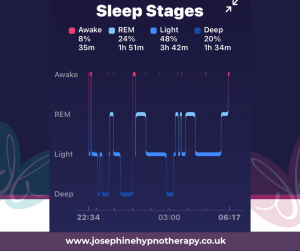 There are 2 types of sleep.
Non-Rapid Eye Movement
(NREM) 75-80% of our sleep, which restores the body, where our brains are idle in a movable body. We dream for 71% of the time during NREM sleep. However, dreams tend to be disconnected, less vivid, more mundane, and less memorable than REM dreams.
Rapid Eye Movement
(REM) 20-25% of our sleep, which restores the mind, our brain is active in a paralysed body. We dream for 95% of the time in REM sleep. Our dreams are usually rich, hallucinogenic, emotional, bizarre experiences. Sleep researchers usually focus on REM dreaming.
Sleep cycle
We sleep in a cycle of approximately 90 minutes, starting the night with deep sleep.
During these early hours of sleep, this improves the retention of information, and learning.
After that, with REM duration increasing later in our sleep, our emotional memories from the day are processed and stored.
We have spikes of awake time throughout the night, which we generally don’t notice. If we have a busy, anxious mind, then these spikes of awake can resurrect the thoughts, and keep us awake. If you can’t get to Sleep, have a read of my blog to get some tips to aid a restful night.
Our Dreams
The reason Why we Dream, allows us to process all the information that we have collected and experienced during the day. Every thought we have, the brain sees as a reality; it can’t tell the difference between imagination or reality. Therefore, every thought will need processing too. Memories are stored in the Hippocampus and processed into our main storage area of the brain.
During the process, our brain creates images, impressions, and narratives to manage the activity going on inside our heads as we sleep.
For instance, it is constantly pattern-matching, finding things in your memory bank to fill in the gaps. In other words, it cannot generate a “real world” reality without feedback from the environment. Therefore, dreams often seem so odd. Because dreams draw on memories and images from your entire life, even though they are only about consolidating memories from that day.
Hypnosis and REM
During our sessions we talk about the importance of Why Do We Sleep and ways to help you get a good night sleep.
 The hypnotic trance in the sessions and listening to my recording, replicates our REM stage of sleep. Our brain uses the metaphors we use to fill in the gaps and pattern-match. Therefore, trance helps consolidate memories, problem solving, and learning.
We help our clients to process anxious, emotional, and ruminating thoughts, helping them to empty their stress bucket.
The power of taking a few minutes rest during the day, lets your brain process, and will improve your performance. Have a listen to my recording below to replicate REM or have a short 30-minute nap ideally before 3pm, and you will feel refreshed. Michael Moseley’s podcast Take a Nap reveals how taking a nap could boost your heart health too.
The wonderful thing with Hypnotherapy sessions is we help improve our clients sleep. There are no negative side effects, as you may experience with some medications. In other words, you have only positive side effects.
I hope you have found the information useful as to the importance of Why we Dream.
If you, or you know someone who needs some help to find their way to having better sleep patterns, maybe they could talk to me.
I offer a free initial consultation phone call, to find out if I’m the right person to help you.