
Can Hypnotherapy Work If You Can’t Visualise?
I’m one of those people who can’t visualise images in my mind. No pictures, no scenes, no mental film. Can Hypnotherapy Work If You Can’t Visualise? I’ve benefited hugely from having Hypnotherapy despite having Aphantasia. That discovery led me on a fascinating journey, both personally, and professionally as a Hypnotherapist.
For a long time, I assumed that when people talked about visualisation, they meant it metaphorically. Then in 2024, I read an article in The Guardian that gave me the lightbulb moment. It made me realise that what I experienced, or rather didn’t experience, was actually a recognised phenomenon called Aphantasia.
What Is Aphantasia?
Aphantasia is the inability to visualise mental images, sometimes called image-free thinking. People with Aphantasia don’t “see” pictures in their mind’s eye. However, they still think, imagine, and remember, just in different ways.
Instead of images, we might think in words, abstract ideas, emotions, sensations, or concepts. It’s simply a different cognitive style, not a limitation. Research suggests around 3–5% of the population experience Aphantasia, although awareness of it is still growing.
Phantasia is a broad visual imagination spectrum. This ranges from extremely vivid, or Hyperphantasia, to no mental imagery at all, Aphantasia.
Interestingly, the idea that people think differently isn’t new. Philosophers such as Aristotle were already pondering imagination and perception over 2,000 years ago. Only recently have we started openly discussing invisible differences in how our minds work. Aphantasia simply gives language to those differences.
“Imagination is not one single way of seeing, but many ways of sensing, knowing, and feeling.”
— Inspired by Aristotle
My Personal Experience with Aphantasia and Hypnotherapy
When I close my eyes and think of an apple, I don’t see it. But I can describe it in detail; the colour, the shine, the crunch, the taste. My memory and understanding are rich and detailed, even without visuals.
I realised that I naturally adapted to Hypnotherapy techniques without knowing why. For example, when a therapist asked me to visualise light flowing through my body, I couldn’t see it. However, whatever colour came to my thoughts, was the correct colour to use. I could feel the physical effects. The relaxation, the warmth, the sense of calm.
So, for me, Hypnotherapy became more kinaesthetic and auditory, about sensations, emotions, and inner dialogue, rather than pictures.
What This Means for Hypnotherapy
Many Hypnotherapy and NLP techniques rely heavily on visual language:
“Picture yourself on a beach…”
“Visualise a light streaming through your body…”
For someone with Aphantasia, this can be frustrating or even anxiety-provoking. I’ve had friends and clients tell me hypnotherapy “didn’t work” for them. When in reality after discussion, they realised that they simply couldn’t visualise and thought they were doing it wrong.
Now, I always ask clients where they sit on the Imagination Spectrum. Some see vivid images, others see very little, and some, like me, see nothing at all.
Can Hypnotherapy Work If You Can’t Visualise?
The good news, yes Hypnotherapy still works. Techniques still work.
I simply adapt the language. Instead of visualise, we use imagine, sense, notice, feel, or be aware of. We tap into auditory, kinaesthetic, emotional, and conceptual thinking styles.
Everyone’s mind processes differently and there is no right or wrong. We work together to understand you and come up with the solution.
“There is no single path to change. When therapy meets your unique way of thinking, transformation becomes possible.”
A Simple Aphantasia Awareness Experiment
If you’re curious, try this simple test that I ask every client:
Close your eyes and think of an apple. Rate how vivid it is on a scale from 5 to 1: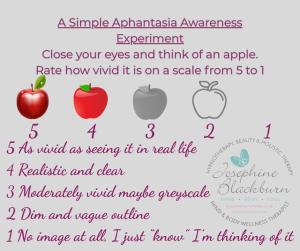
5 – As vivid as seeing it in real life
4 – Realistic and clear
3 – Moderately vivid
2 – Dim and vague
1 – No image at all, I just “know” I’m thinking of it
This simple test can highlight how differently we experience imagination. To find out more then do visit the Aphantasia website.
Why This Matters in Therapy and Everyday Life
Understanding Aphantasia and Hypnotherapy has changed how I work as a therapist. It has reminded me that language matters. Not everyone experiences guided imagery the same way. Adapting techniques to the individual reduces anxiety and increases effectiveness.
The mind is absolutely fascinating. No one can see into another person’s inner world, and what we “see” or “feel” is shaped by our beliefs, memories, and perceptions.
Final Thoughts
Aphantasia hasn’t limited my experience of Hypnotherapy. It has enriched my understanding of how diverse and adaptable the mind truly is. Whether you visualise vividly, sense emotionally, or think in concepts, Hypnotherapy sessions can be tailored to you.
I’ve personally worked successfully through the Mind Reboot techniques as an aphant, proving that visualisation is not a requirement for deep change. The Mind Reboot which is part of my Butterfly Program, is designed to work with your natural thinking style, whether that’s visual, auditory, kinaesthetic, olfactory, gustatory, or conceptual.
Aphantasia and Hypnotherapy: Yes, Hypnotherapy Can Work If You Can’t Visualise.
If you’ve tried hypnotherapy before and felt it didn’t work, or you still have concerns about whether it’s right for you, a simple conversation could make all the difference. I offer a free, no-obligation consultation so we can explore what would work best for your mind and your goals.
And that is the beauty of personalised therapy.
I am a full member of the AfSFH, NCH and CNHC, fully compliant with all their codes and ethics. I have full public liability am qualified, verified, and fully insured through BABTAC, with an enhanced DBS certificate through the NCH.