
My Personal Story
March marks Endometriosis Awareness Month, and in 2025, the theme is ‘Endometriosis Explained.’
To contribute to this awareness of Endometriosis Symptoms, Diagnosis and Self-Care, I share My Personal Story of Living with Endometriosis. Above all, shedding light on its impact on daily life.
My Personal Story
 My story began when I got my first period at just 10 years old. Right from the start, my periods were irregular, excessively heavy, and unbearably painful.
I assumed that was normal, after all, isn’t that just part of being a woman? I couldn’t have been more wrong.
I suffered for many years thinking everyone was experiencing the same. As a result, the GP prescribed strong painkillers which didn’t help.
After 16 years of suffering, a friend told me that the level of debilitating pain I experienced was not normal period pain. Looking back, it’s incredible how I kept going under this false belief.
My Endometriosis Symptoms
My period pain was so intense that my body would go into shock. I’d be physically sick, pass out, and be left curled up with a hot water bottle until I could function again. I felt like my insides were falling out of me when going to the toilet or changing sanitary wear. As a self-employed woman, I couldn’t afford to take a day off just because of my period, so I had no choice but to push through the agony. This went on for the duration of the bleed, then with sometimes as little as a 10-day reprieve, I would start again.
The impact wasn’t just physical, there were psychological effects too, which put a strain on my relationships. Sex was excruciating, like being stabbed with knives. Tears would stream down my face. My boyfriends who showed little to no empathy.
My Endometriosis Diagnosis
At 26, in 1996, I finally found a GP who took my pain seriously and referred me to a gynaecologist. A laparoscopy confirmed my diagnosis. Endometriosis was found around my ovaries, fallopian tubes, the ligaments supporting my uterus, and chocolate cysts. Finally, I had a name for my condition. But then came the devastating news, there was no cure. Just manage the symptoms on a temporary basis with hormone treatments to stop my periods, and practice self-care.
My Treatment
I underwent six months of Zoladex implant hormone injections, which threw me into temporary menopause for a year. Yet, my symptoms returned.
Another laparoscopy, then advised to Tri-packet the contraceptive pill for years until I tried for a baby. I was extremely grateful that I fell pregnant and had my daughter.
After recovering from the caesarean birth, I had a Mirena Coil fitted, which has helped suppress my monthly bleeds.
Psychological Effect
Periods, let alone Endometriosis, weren’t talked about back then. At the time, Endometriosis wasn’t widely recognised. No one around me had even heard of it, leaving me feeling incredibly alone. This isolation took a huge toll on my mental health. There was no support system. Back then no social media groups, no regular medical follow-ups. I was simply left to come to terms with a lifelong disease that would continue to affect me through menopause and beyond.
 Endometriosis symptoms appear in many ways. It’s something you can’t see from the outside, but very much you feel on the inside.
Have I still got it?
Who knows, I haven’t seen an Endometriosis consultant since 2002! I still experience endo-belly bloating, lower back and hip pain, cysts, inflammation, intestinal cramping, and pelvic pain. Yet my GP dismisses it as IBS.
Final Thoughts and Self-Care
Over the years, I’ve done extensive work on myself to better manage my symptoms and pain. Through the Hypnotherapy Mind Reboot, I confronted the trauma linked to my diagnosis and years of suffering. I have worked a lot on my Self-care, keeping fit with strength and Pilates, mindfulness, physio, and activities that produce endorphins, our bodies natural painkiller.
This needs to be talked about in schools. Both girls and boys should be educated about Endometriosis, so they understand the difference between ‘normal’ period pain and something far more serious. 29 years on (to date) and although there have been some advances, it saddens me that women are still having a battle to get their diagnosis. It affects 10% of women, assigned female at birth, globally.
What Is Endometriosis?
Endometriosis occurs when cells similar to those in the lining of the uterus grow in other parts of the body. Each month, these cells respond to hormonal changes just like the uterine lining, but because they have no way to exit the body, they form ‘chocolate’ cysts, leading to inflammation, pain, and scar tissue.
The condition most commonly affects the pelvis, as it did in my case. However, it can also develop on the bowels, bladder, and, in rarer cases, outside the pelvic region.
Types of Endometriosis
These refer to the location of the lesions, it is possible to have more than one:
- Peritoneal (superficial) endometriosis – found mainly on the pelvic peritoneum.
- Ovarian endometriosis (endometrioma) – endometriosis cysts are found in the ovaries.
- Deep endometriosis – found in locations such as the bladder, bowel and recto-vaginal septum.
- Extra-pelvic endometriosis – found outside of the pelvis, such as the thorax and caesarean scars.
Treatments
Currently, there is no cure for Endometriosis.
However, I was pleased to read in the BBC News there is now a tablet, Relugolix for suppressing the monthly bleeds, a chemical menopause without the hideous injections I had. The tablets are only available when all other treatments have been tried and not helped.
Support For Endometriosis
You can find lots of information about Endometriosis Symptoms, Diagnosis and Self-Care on the NHS website. Many people have openly shared their Personal Story and experiences too.
Endometriosis UK provides so much information and support. There are campaigns to the Government to provide more support and funding into women’s reproductive health conditions.
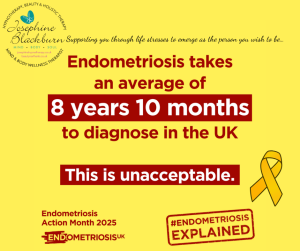
International Women’s Day 2025 in conjunction with World Health Organisation are globally calling for more investment in research in Women’s health including Endometriosis, #AccelerateAction for gender equality. The hope is to help reduce the time for women receiving a diagnosis and treatment they need. On average 8 years of suffering with debilitating symptoms.
Hypnotherapy certainly helped my mental health, albeit not at the time I really needed the support. The long-term mental health implications are just as debilitating as the physical symptoms. My Butterfly Program incorporates the Mind Reboot to help you get to the heart of what will bring you the most calm and peace. To restore your daily life back to what you see as a sense of stability and ease. Unlock a brighter, more empowered you. Helping you say goodbye to your anxieties, managing your pain, and welcoming a clearer, rejuvenated mindset to cope with the diagnosis.
In Conclusion
I hope you have gained some knowledge about Endometriosis Symptoms, Diagnosis and Self-Care. Likewise finding comfort and hope through My Personal Story.
Maybe you have concerns about someone you love. We can’t always provide the support we’d like to for those in our care and feeling helpless as we watch them suffer is so hard. Please make them aware that there is help and support out there.
Maybe they could talk to me. At the free consultation, we will determine if Hypnotherapy is the right way forward for you. Consequently, you will be able to decide if you would like to work with me.
We can successfully work remotely over Zoom should we not be co-located. This way is just as effective as when I see clients in person. But if you are local and prefer to be in a calm space away from your own concerns, my private room in Great Addington is the perfect place for you.
Supporting you through life stresses to emerge as the person you wish to be…
I am a full member of the AfSFH, NCH and CNHC, fully compliant with all their codes and ethics. I have full public liability am qualified, verified, and fully insured through BABTAC, with an enhanced DBS certificate through the NCH. Please do visit my terms & conditions