It is important for parents to have an Understanding of the Teenage Brain. As a parent of a teenager who has lived through our acrimonious divorce, grandparent passing away, and the pandemic, I wanted to understand more. What makes them tick and behave the way they do. Why they sometimes turn to harmful coping techniques. And most importantly, how to help them.
Low self-esteem
Teenagers with low self-esteem believe that they are unlovable, undesirable, worthless, and more. These beliefs can carry through the rest of our life, impacting adult mental health. This can have an impact their physical health.
These shocking statistics highlight the issues afflicting teens self-worth:
- 5m children in the UK have struggled since the start of Covid-19.
- 94% of ages 5-19 years have felt anxious, lonely, and sad through the pandemic.
- 50% of mental health disorders are established by the age of 14, while 75% are established by age 24.
- Nearly 20% of teens experience depression before they reach adulthood, of which 30% receive treatment for their depression.
- There has been a high increase in children engaging in self-destructive behaviours, such as cutting, bullying, drinking, smoking, and eating disorders, even as young as primary school age.
- 7 out of 10 girls believed that they were not good enough or did not measure up to others, whether in looks, relationships, or academic performance.
- Over 5% of teenagers reported substance abuse or alcohol use.
- 40% of teenage boys reported exercising regularly to increase muscle mass.
- 38% of teenage boys reported using protein supplements, and 6% admitted to steroid use to improve their physique.
- 38% of teens are struggling with sexuality and gender.
- Suicide is the third leading cause of death among young people ages 15-24.
- Every 100 minutes a teenager will have died by suicide.
Effects of the pandemic
 Teenage years are tough enough without the additional effects from the Covid-19 lockdown. We are naturally social beings, we function better in a tribe. Therefore when we are forced into isolation from others, it promotes a depressed way of living.
There’s a kind of ‘grief’ from the affects. They’ve lost a lot of their life with not being able to go to school. Not being able to see their friends or go out. Maybe family bereavement too. Along with physical, hormonal, and emotional changes.
The added pressures of social changes, new relationships, and increased educational expectations. Parent break ups, leading to increased financial insecurity. Peer pressure, and impossible societal ideals which are spread by the media, society and often parents. All these contribute to low self-esteem, leading to drastic effects that not only affect a child’s mental health, but their physical health as well.
Signs that your teenager is struggling with low self-esteem
- They find it difficult to engage with the world.
- Spending a lot of time on their own.
- Withdrawn and don’t have the same enjoyment from life.
- Abnormal eating patterns. Not eating or binge eating.
- Weight loss or gain.
- Low energy and staying in their ‘cave’ more than normal.
- Self-harming.
- Comparing themselves to others, feeling inadequate.
Big changes in teenage years
Not only do they have physical and hormonal changes to contend with, but they are also naturally more emotional. Which means they can be particularly fragile. Their self-esteem is often easily damaged and difficult to repair.
They have moved from the protection and being ‘King Pin’ at primary school, with the parent being in control.
To this huge change to bottom of the chain again. Forming new friendships, finding where they fit in to their new tribe. Having more independence and own decision making. Parents aren’t needed as much which is why ‘they know best’ and the typical Harry Enfield’s ‘Kevin’ behaviour starts!
What happens in the teenage Brain?
The most important thing to remember is their emotional primitive brain is running the show. It’s much larger than the intellectual prefrontal cortex (PFC) in the teenage years. Their brains are undergoing massive change, the brain chemistry changes quickly. A rollercoaster ride of happy one minute, to anxious, angry, hypersensitive to social situations, or emotional the next. Which is why they behave as they do and can be impulsive! By having an Understanding of the Teenage Brain, makes life easier for parents to live with a teenager.
Pre-Teen
In young children the brain is like a sponge. The grey matter of the PFC thickens, as neurons make new connections or synapses. They absorb everything and learning without the fears. Hence toddlers don’t know their limitations and you need eyes in the back of your head to keep them safe! They need to sleep a lot because they’re exhausted! The volume of grey matter peaks at puberty then declines during the teenage years into mid-20s.
Teenage
Once they reach teenage years, they’ve learnt the basics. Consequently, the brain undergoes synaptic pruning in the grey matter to allow for more learning. The connections that have been strengthened, aren’t pruned away. Hence ‘use it or lose it’.
Each time they sleep the ‘pruning’ process begins.
Imagine a garden. You know when it’s that time of year to prune back the trees and bushes. The old, dead branches that serve no purpose can be cut away.
That’s the same in the brain. Teens don’t need to store all the information that they know as automatic responses. Also, synaptic pruning is hard work, which is why teens need to sleep a lot.
However, as we know, teenagers also like to push the boundaries too and stay up all night. They don’t want to miss anything, so they are the last one standing. If they ‘miss something’, then the next day at school can mean they are ostracised because they’re not in the loop. Unfortunately, anxiety can build up because they are not getting the right amount of synaptic pruning, and it’s easy for the wiring to go awry.
Jay Giedd, a neuroscientist at the University of California, discovered that increased white matter means the connections between brain regions become stronger and more numerous. This increases throughout childhood, adolescence and into adulthood, becoming more interconnected and specialised.
To use Giedd’s metaphor, “brain maturation is not so much a matter of adding new letters to the alphabet but one of combining existing letters into words, words into sentences and sentences into paragraphs.’
‘These changes ultimately help the brain to specialise in everything from complex thinking to being socially adept.”
The prefrontal cortex, intellectual brain, doesn’t fully develop until 25yrs+. Resulting in emotions being regulated easier. Although if the teenage years have been with heightened anxiety and low self-esteem, then the mental health issues can carry on through adult life.
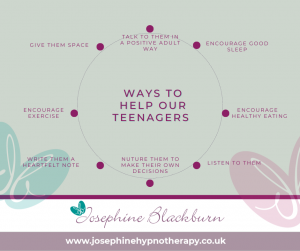
Ways to help our teenagers
- Lead by example by talking to them in a positive way, avoiding criticism.
- Gently encourage them to get a good night sleep. In my blog Can’t get to Sleep I explain ways to help achieve a good night sleep.
- Nurture them to undertake their own decision making, within reasonable parameters!
- Inspire them to eat healthily and exercise.
- Guide them to accept themselves. Practice self-love, and love those around them. There are some good tips in my blog How to Self-Care.
- Build trust by listening. Find out how they feel. Take an interest in their lives.
- Know when to give them space.
- Write a positive heartfelt note to them, full of words of support and affirmation. Let them know they are loved.
- Every day, encourage teens to write one positive thing about themselves. Written down so they can look back at all the good things.
- Ask them if they would like professional help. Sometimes it’s easier to talk to someone who isn’t a parent! Life skills embedded in at this early age will carry forward throughout their lives. Take a look at my YouTube channel for some coping techniques.
I’m here to help
I hope this has given you a good insight and an understanding of the teenage brain.
Not only have I experience of bringing up a teenager, I have attended two courses in ‘Safeguarding and Working with teenagers to 25-year olds’. These have provided me with a more in-depth knowledge on their brain development and the issues teenagers are currently facing. I have an enhanced DBS certificate through the NCH.
Whether you yourself are struggling to cope, or you have concerns about someone you love, a conversation with me might give you the answers you’ve been looking for. Find out if I am the right therapist for you. Book for a free initial consultation.